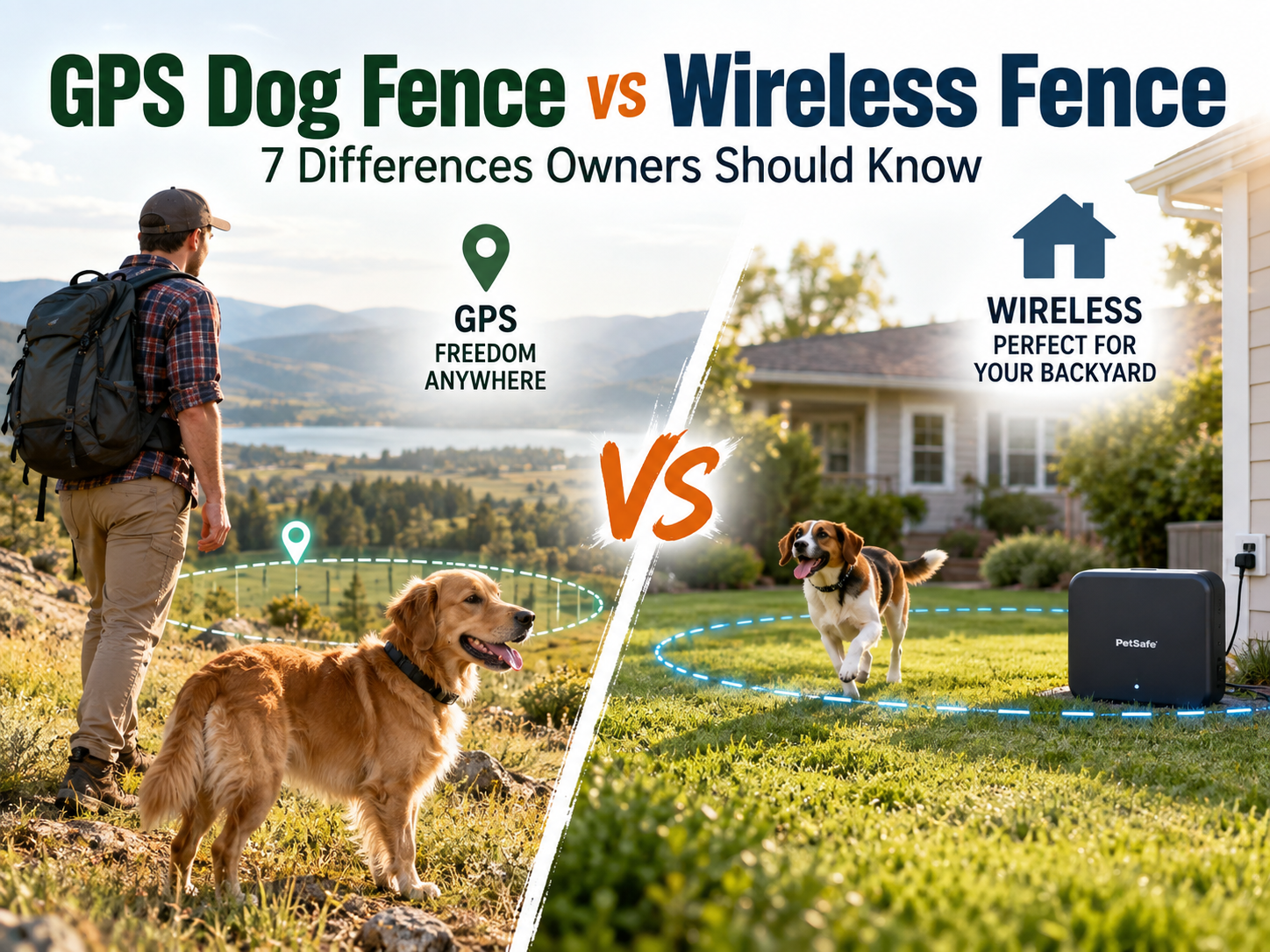
Two products can both be called a “wireless dog fence” while using completely different technology.
One may create a circular boundary around a plug-in transmitter inside your home. Another may use GPS satellites to calculate whether your dog has crossed a virtual boundary outdoors.
That difference matters more than the word wireless on the box.
If you have a typical backyard, does GPS actually give you anything you need? If you manage two acres, a farm, or a large rural property, will a transmitter-based fence cover the area you want? And if GPS sounds more advanced, does that automatically make it the better choice?
No.
The better question is: which boundary technology fits your property and your dog?
How GPS Dog Fences and Regular Wireless Fences Actually Work
Both create invisible boundaries, but they determine those boundaries in very different ways.
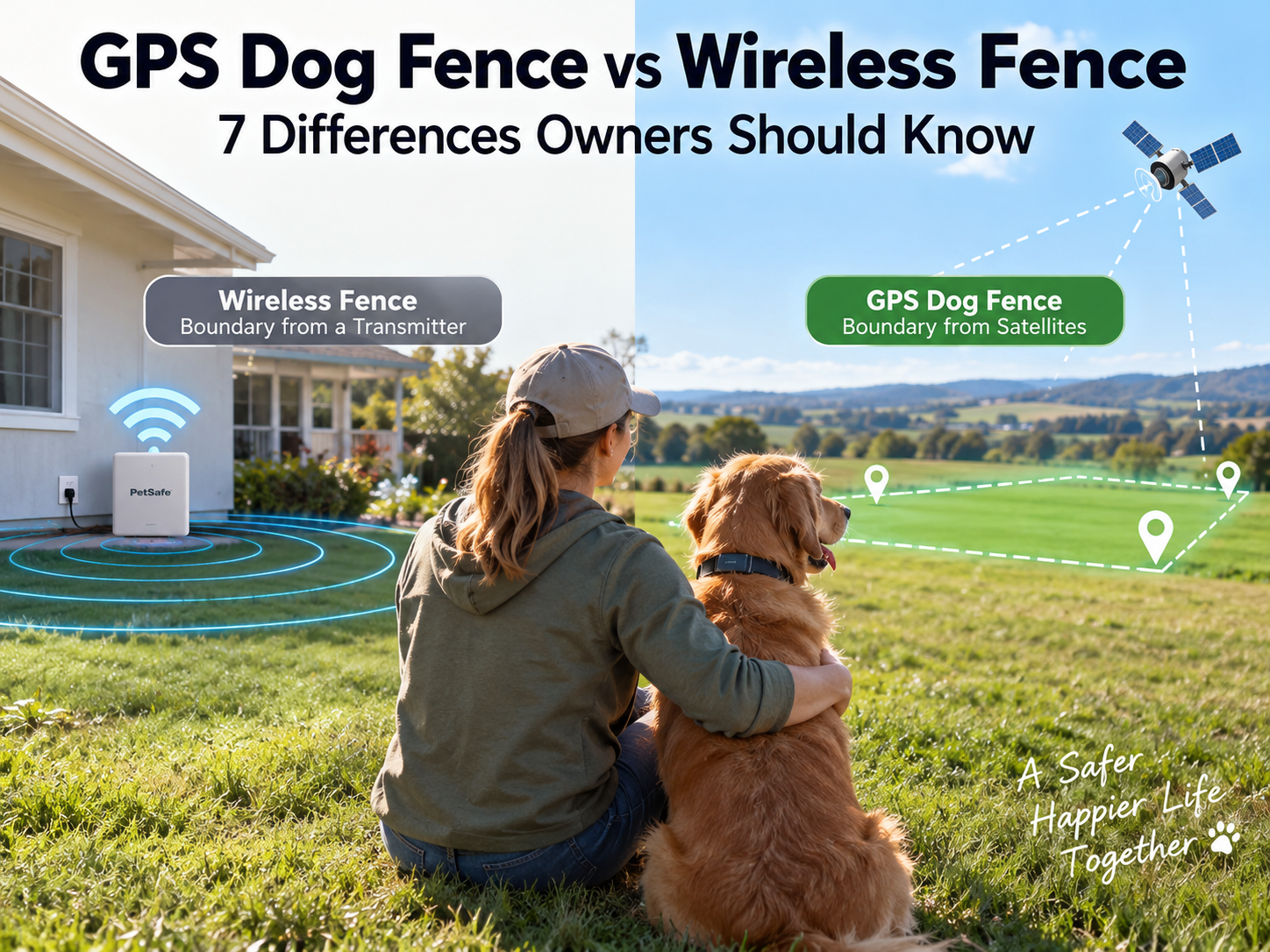
A regular wireless dog fence usually relies on a fixed transmitter placed inside or near the home. The transmitter creates a radio boundary, and a receiver collar responds as the dog approaches that boundary.
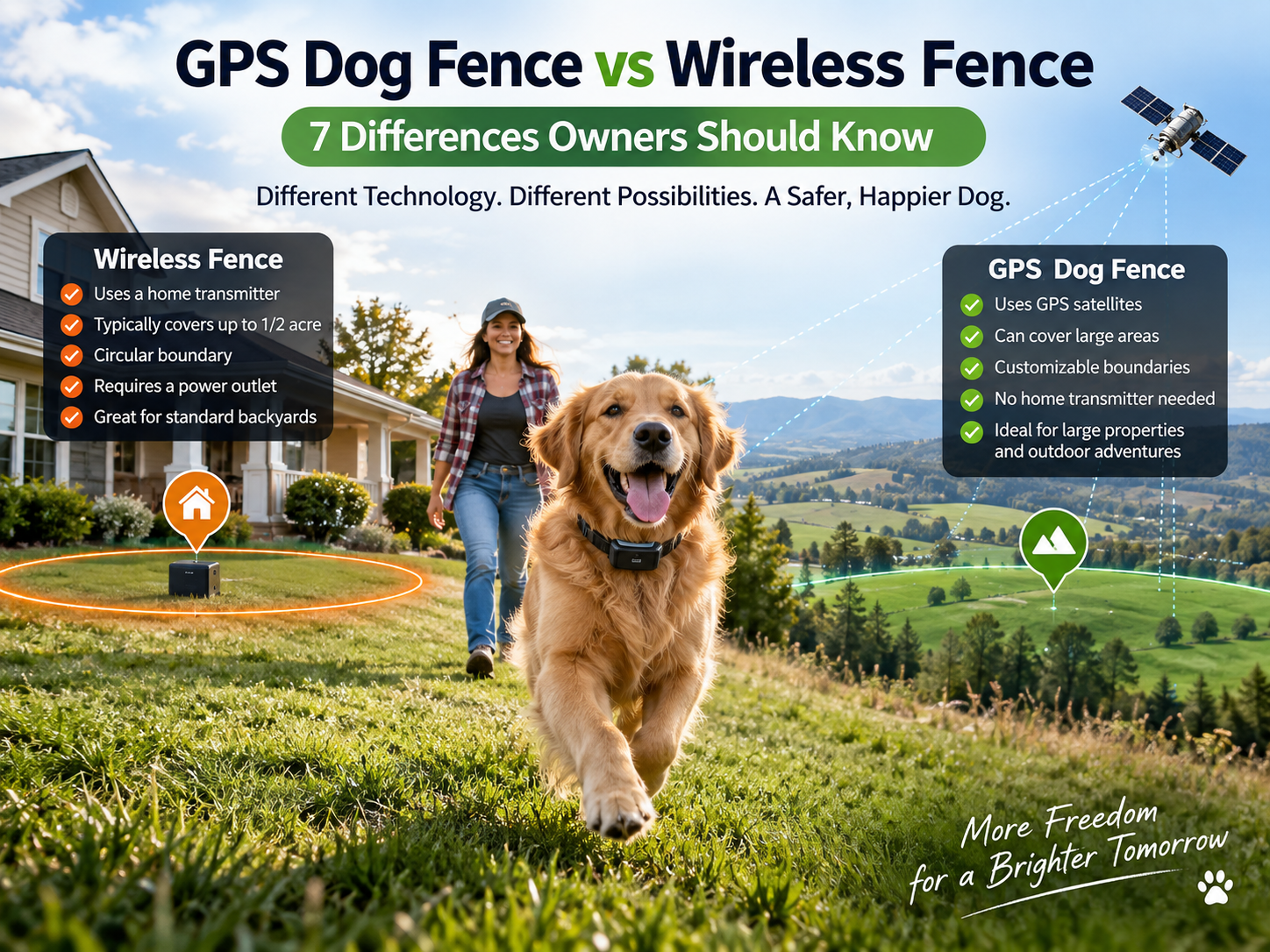
Take one current PetSafe system as a useful industry example. Its transmitter creates an adjustable circular boundary covering up to half an acre. The system can be moved for travel, but the transmitter still needs an electrical outlet at the new location.
So even though there is no buried perimeter wire, there is still a physical center to the system:
the transmitter.
A GPS dog fence takes a different approach.
Instead of measuring the dog's relationship to a nearby transmitter, the collar determines its geographic position from satellite signals and compares that position with a stored safe area.
The NAX100 is one example of this architecture. It uses GPS positioning to establish a wireless safe area without perimeter wire, with a configurable radius reaching up to 1,000 meters.
That gives us the simplest way to understand the difference:
A regular wireless fence builds a boundary around a transmitter.
A GPS fence builds a boundary around a geographic position.
Everything else—range, portability, installation, and environmental limitations—flows from that distinction.
For a broader introduction, see our GPS dog fence manufacturer guide.
7 Differences That Matter in Real-World Use
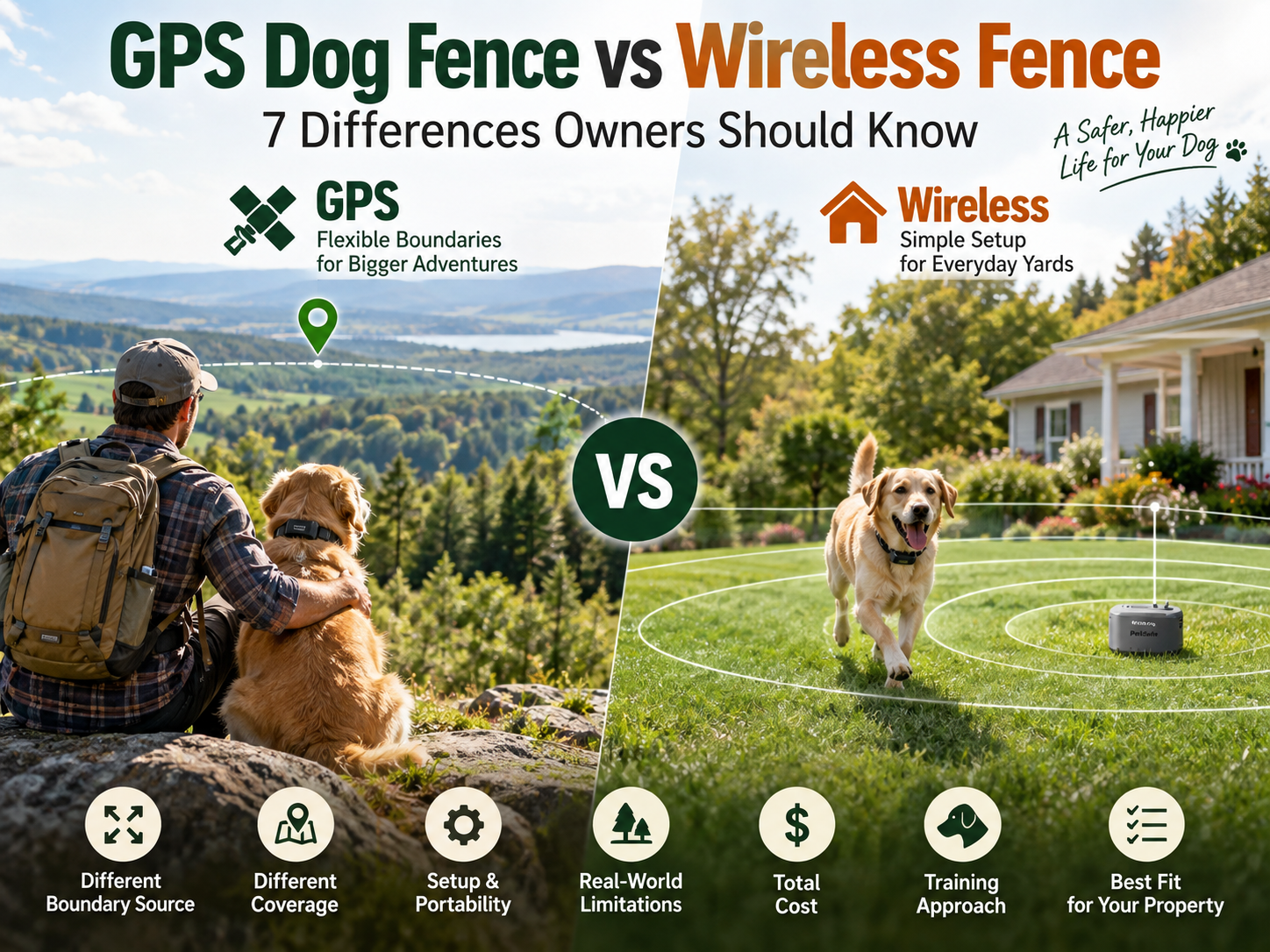
Do not start by comparing prices or the biggest number on the product page. Start with how each system fits the land.
1. The Boundary Comes From a Different Source
With a transmitter-based wireless fence, the local transmitter is the reference point.
The collar responds to the radio field created around that unit. Depending on the product, you can usually increase or decrease the size of the field, but the transmitter remains at the center of the system.
With a GPS fence, geographic positioning becomes the reference.
The device establishes where it is and calculates whether the dog is still inside the permitted area.
That may sound like a technical distinction. In practice, it determines how you expand the boundary, move it, and rebuild it somewhere else.
2. Coverage Can Be Very Different
For many suburban dog owners, extreme range is irrelevant.
PetSafe's Wireless Pet Containment System, for example, creates an adjustable circular boundary of up to half an acre, with a maximum diameter of 180 feet. That may be more than enough for a conventional residential yard.
The situation changes when you are working with a much larger property.
The NAX100, for example, allows its GPS safe-zone radius to be adjusted from 30 meters to 1,000 meters, with distance settings increasing in 10-meter steps.
That does not mean every GPS dog fence has a 1,000-meter range.
It is a specification of this particular system.
The more useful lesson is architectural: GPS-based containment can create large virtual areas without requiring a home transmitter to generate the entire perimeter.
On a large open property, that difference can become significant.
3. Regular Wireless Fences Usually Need a Fixed Base
The word “wireless” causes a lot of confusion.
People often hear it and assume there is no fixed equipment at all.
What these systems usually eliminate is the buried boundary wire—not necessarily the base station.
The PetSafe example still uses a transmitter, and although it is portable, the manufacturer specifies that an outlet is required when using it in another location.
A standalone GPS fence collar can work differently.
With the NAX100, for example, the device acquires GPS signals outdoors, establishes an initial reference point, and then lets the user define a safe-area radius from that position.
If your dog always uses the same backyard, this difference may not matter very much.
If the location changes regularly, it can matter a lot.
4. Both Can Be Portable—but They Move Differently
I often see a misleading comparison online:
“GPS fences are portable. Regular wireless fences are not.”
That is too simple.
Some transmitter-based wireless systems are specifically designed to travel. PetSafe, for instance, describes its system as portable as long as you can place and power the transmitter at the new location.
The real difference is how you redeploy the boundary.
Move a transmitter system, and you need to find a suitable transmitter position, connect it, and establish the wireless field again.
Move a GPS system, and the process can instead center on acquiring a new position and defining a new geographic safe area.
The NAX100 allows the user to reset the initial GPS reference point when the dog's activity location changes.
So portability is not exclusive to GPS.
Reduced dependence on a fixed transmitter location is the more meaningful distinction.
5. They Have Different Environmental Weaknesses
Here is where I would push back on one common assumption:
GPS does not mean “works perfectly everywhere.”
GPS.gov explains that real-world positioning depends on factors including satellite geometry, signal blockage, atmospheric conditions, and receiver quality. Buildings, bridges, and trees can reduce accuracy, while signals reflected from buildings or walls can create multipath errors.
That matters for GPS pet products.
The NAX100 is designed to acquire its satellite position in an open outdoor area. Its operating instructions note that initial positioning normally takes roughly one to two minutes and that buildings, obstacles, and weather conditions can affect signal reception.
Transmitter-based wireless fences avoid the satellite-visibility issue, but they have environmental considerations of their own.
For example, PetSafe states that one of its wireless-fence transmitter products is not compatible with structures that have metal siding or metal roofs.
Neither technology is environmentally neutral.
They simply respond to different environmental variables.
6. Changing the Safe Area Works Differently
If your dog uses one backyard for years, you may rarely care how easy a boundary is to relocate.
On a large property, that can change.
Maybe the dog uses one part of the land during one season and another area later. Maybe you spend time at a second property. Maybe you want to establish a different outdoor zone temporarily.
A conventional wireless fence changes its boundary through transmitter placement and system settings.
A GPS system can instead redefine its geographic reference point.
On the NAX100, once positioning is complete, the current location can be established as the center of the safe area and the radius adjusted from there.
Ask yourself this before buying:
How often will I actually need to move the boundary?
The answer can be more important than maximum range.
7. They Tend to Fit Different Property Types
This is where the comparison finally becomes practical.
If you have a fixed small-to-medium residential yard, reliable power, and a suitable transmitter location, a transmitter-based wireless fence may provide exactly the level of complexity you need.
Simple can be valuable.
If you are managing a large open lawn, rural property, farm, or an activity area well away from the house, GPS-based containment becomes more interesting because it does not have to build the entire boundary around a plug-in transmitter.
But the reverse is also true.
If your yard is extremely small or surrounded by significant satellite obstructions, buying GPS simply because it sounds newer makes little sense.
Choose the system around the property. Do not try to force the property around the system.
Why Dog Owners Often Buy the Wrong Type of “Wireless Fence”
Most bad purchases I see begin with a misunderstanding of the problem, not a bad specification.
- “Wireless” gets interpreted as “no fixed equipment.”
The owner opens the box and discovers that a transmitter still needs a suitable location and power source. Wireless perimeter and transmitter-free operation are not the same thing.
- Maximum range becomes the only comparison.
A 1,000-meter specification sounds impressive, but it has little value if your usable yard is only 25 meters across. Bigger numbers do not automatically create a better fit.
- A large property gets paired with the wrong boundary geometry.
If the house sits near one edge of the land, a transmitter-centered circle may not match the area where the dog actually needs to roam. The problem is geometry, not necessarily product failure.
- A GPS product is purchased without checking satellite conditions.
Dense trees, surrounding buildings, and other obstructions can change real-world GPS performance. That environment should be considered before purchase.
- An electronic boundary gets treated like a physical fence.
An electronic system can help teach a dog where its permitted area ends, but it does not physically stop another animal, person, or vehicle from entering the property.
- Correction is expected to replace training.
A dog does not automatically understand why a collar beeped. It has to learn what the boundary signal means and what response is expected.
This is exactly where property scale starts to matter. A 30-to-1,000-meter configurable GPS radius gives the Naxwave NAX100 a very different use profile from a small transmitter-centered yard system—but range still does not replace training or environmental assessment.
A specification only matters when it solves your actual problem.
Before and After: A Two-Acre Property Example
The right way to evaluate containment is to measure behavior, not just whether the collar activates.
Consider an illustrative scenario based on a common large-property problem.
This is not a real customer case and the numbers below are simulated evaluation data, not product performance claims.
A family owns roughly two acres of land with the house positioned toward one side of the property. Their energetic medium-to-large dog spends most of its outdoor time on grass behind the house.
Before
Their transmitter-based wireless fence works as designed.
The challenge is the layout.
The desired dog area does not line up particularly well with a circle centered on the house. Increasing the radius would also extend the boundary into areas the owners would rather keep off-limits.
They decide to track three measures for one week:
- Number of boundary-warning events
- Average time required for recall
- Amount of the intended outdoor area the dog can comfortably use
For our simulated baseline, assume they record nine boundary-warning events in a week and an average recall time of roughly 40 seconds.
After
They shift to a GPS-based approach, move the reference point closer to the intended activity area, and repeat boundary training.
A product such as the Naxwave NAX100 illustrates this approach because its GPS reference point can be reset and its safe radius adjusted for the location.
In the illustrative follow-up data, weekly warnings fall from nine to three, while average recall time drops from 40 seconds to about 20.
That is a 67% reduction in warning events in the scenario.
It is not a promised product outcome.
The useful part is the method: measure whether the dog's behavior becomes more predictable after you change the boundary setup.
An illustrative owner comment might be:
“I needed the boundary to fit the land, not the land to fit the boundary.”
That is the real Before-and-After question.
Which Technology Fits Your Situation?
Instead of asking which fence is “better,” put your property into one of three practical categories.
Scenario A: A Fixed Small or Medium Yard
A transmitter system can make a lot of sense here.
The current PetSafe example covers up to half an acre, creates an adjustable circular boundary, and lists a setup time of about one to two hours.
If the coverage fits, the location never changes, and the transmitter can sit where it needs to sit, extra complexity may add little value.
Enough is enough.
Scenario B: A Large Open Property
Now the questions change.
How far does your dog actually need to roam?
Is the house in the right place to serve as the center of a transmitter field?
Will the activity area change?
Would you prefer the boundary reference to exist in the collar rather than depend on a fixed home base?
The Naxwave NAX100 provides one example of the GPS approach: a 30-to-1,000-meter adjustable radius, GPS positioning, audible warning, vibration and static stimulation options, a rechargeable battery, and a waterproof design.
As the dog approaches the boundary, the system can provide an audible warning first. If the dog continues outside the safe area, enabled vibration or static modes can follow, and the stimulation stops when the dog returns.
It also includes an over-correction protection sequence that limits repeated vibration and static cycles rather than allowing those modes to continue indefinitely.
Those are training-support functions.
They should never be treated as a competition to see which collar produces the strongest correction.
Scenario C: A Very Small or Heavily Obstructed Yard
This is where bigger GPS specifications can become irrelevant.
The NAX100 itself has a minimum configured radius of 30 meters, specifically to avoid an excessively small initial boundary.
If your usable space is substantially smaller, that specification should immediately become part of your decision.
Likewise, heavy satellite obstruction deserves attention before choosing a GPS-based system.
Newer technology is not automatically better-matched technology.
GPS Dog Fence vs. Regular Wireless Fence at a Glance
| Factor |
GPS Dog Fence |
Transmitter-Based Wireless Fence |
| Boundary reference |
Geographic GPS position |
Local radio transmitter |
| Fixed transmitter |
Not required by some standalone designs |
Usually required |
| Boundary design |
Depends on product |
Commonly circular |
| Large open properties |
Often worth considering |
Depends heavily on transmitter coverage |
| Relocation |
Can reset geographic reference on compatible models |
Move and redeploy transmitter |
| Satellite visibility |
Important |
Not required |
| Base-station power |
Not required by some standalone collars |
Usually required |
| Main environmental concerns |
Buildings, trees, blockage, multipath |
Transmitter placement, structures, local RF conditions |
| Typical fit |
Large/open or frequently relocated areas |
Fixed small-to-medium residential yards |
This table compares technology architectures, not universal specifications.
Always check the requirements of the exact model you intend to use.
Where the Market Is Moving in 2026
Pet containment is increasingly becoming part of the wider wearable-technology market.
Years ago, conversations about electronic dog fences mostly started with the property.
Where does the wire go?
Where does the transmitter sit?
How much yard can the system cover?
More sensing, location, processing, and communication capability is now moving onto devices worn by the pet.
Grand View Research estimates that the global pet wearable market was worth about $3.4 billion in 2025, rising to an estimated $3.8 billion in 2026, with a forecast of $11.4 billion by 2033. Its projected compound annual growth rate for 2026–2033 is 16.8%, and GPS is among the technology categories covered in the research.
That does not mean the GPS dog-fence market itself will grow at exactly that rate.
It tells us something broader: location-aware pet devices are part of a growing wearable ecosystem.
After years of watching smart-pet products evolve, I do not expect one fence technology to eliminate the other.
I expect clearer specialization.
Small fixed yards will continue to reward simple transmitter systems. Large properties and changing outdoor environments will create stronger demand for devices capable of making location decisions on the collar itself.
Not every owner needs more technology. Complex properties simply give location technology more problems to solve.
3 Tips You Can Use This Week
Tip #1: Measure Your Real Boundary Before Shopping
Start with the land, not the product page.
Measure from the point you would use as the center of the safe area to the furthest place your dog should be allowed to reach.
Then look at the shape of the property.
Is the house centered? Is the yard long and narrow? Are there roads or restricted areas on one side?
Expected result: Within one week, you should have a realistic target radius and be able to eliminate products that clearly do not match it.
Tip #2: Test the Environment, Not Just the Specification
If you are considering GPS, walk through the intended activity area and look at the sky exposure.
Buildings, heavy tree cover, and physical obstructions deserve attention because GPS.gov identifies signal blockage and multipath reflections as common causes of reduced positioning accuracy.
If you are considering a transmitter system, identify exactly where the base would go, where its power comes from, and whether the building materials create manufacturer-specific restrictions.
Expected result: Identify at least one environmental compatibility risk before spending money.
Tip #3: Track Seven Days of Boundary Training
Do not finish the week saying, “I think my dog is getting it.”
Write down three numbers every day:
How many times did the dog approach the boundary?
How many times did the dog turn back after the warning?
How many times did you need an additional recall command?
Expected result: After seven days, you will have a measurable training baseline instead of relying on memory.
Key Takeaways
- GPS and regular wireless dog fences differ mainly in how they establish the boundary: geographic positioning versus a local transmitter.
- GPS systems can be especially relevant to large, open, or frequently relocated activity areas, but satellite conditions still matter.
- Transmitter-based wireless fences remain practical for many fixed residential yards. More technology is not automatically more useful.
- Maximum range should never be your only buying criterion. Property geometry, environment, power, relocation needs, and training all matter.
- An electronic boundary supports training; it does not replace training or become a physical barrier.
The Question to Ask Before You Buy
The next time two products both say “wireless dog fence,” do not start by asking which one has the bigger number on the box.
Ask this instead:
How does this system know my dog has reached the boundary?
Once you understand that, it becomes much easier to understand what type of property the system was built for.
What has been the hardest part of managing your dog's boundary—limited coverage, changing locations, or a dog that keeps testing the edge?
Do you think GPS virtual boundaries will become more common on large properties while transmitter systems remain popular in conventional residential yards?
And if you could solve only one problem today, what matters most: more roaming space, simpler installation, or easier relocation?
Tag a dog owner who needs to read this before choosing a wireless fence.
#GPSDogFence #WirelessDogFence #DogTrainingCollar #PetSafety #PetTech #SmartPet #DogTraining #DogOwners #Naxwave #NaxwavePet
Explore GPS dog fence products