GPS Dog Fence No Subscription: What Buyers Should Know

WELCOME TO OUR BLOG

We're sharing knowledge in the areas which fascinate us the most
click

GPS Dog Fence No Subscription: What Buyers Should Know

By GPS pet collar September 12th, 2026 49 views

A GPS dog fence without a subscription can be a practical choice if you want virtual pet containment without adding another monthly bill. But “no subscription” does not tell you everything you need to know about the system.

Two subscription-free GPS fences can work very differently. One may operate entirely as a standalone collar system, while another may still depend on a smartphone app or connected services. Some GPS fences provide containment only, while others offer optional paid plans for live location tracking. And some products require an active membership even for the fence itself.

Before buying, the useful question is not simply “Does this GPS dog fence have a monthly fee?” It is: “What functions work without a subscription, what technology does the system depend on, and does that match what I actually need?”

Key Takeaways

  • A no-subscription GPS dog fence eliminates a required recurring fee for the functions covered by that purchase, but it does not automatically mean no app, no cellular connection, or no Wi-Fi.
  • GPS pet containment and live GPS dog tracking are different functions. A fence can work without providing your dog’s exact position on a smartphone map.
  • Boundary shape, property size, GPS environment, training method, and portability can matter more than the absence of a monthly fee.
  • If you mainly need outdoor containment and do not need live-map tracking or a connected smart ecosystem, a standalone system can be a simpler option.
  • Product architecture varies considerably, so verify exactly which features remain available without an active plan.

For a broader introduction, see our GPS dog fence manufacturer guide.

What Does “No Subscription” Actually Mean for a GPS Dog Fence?

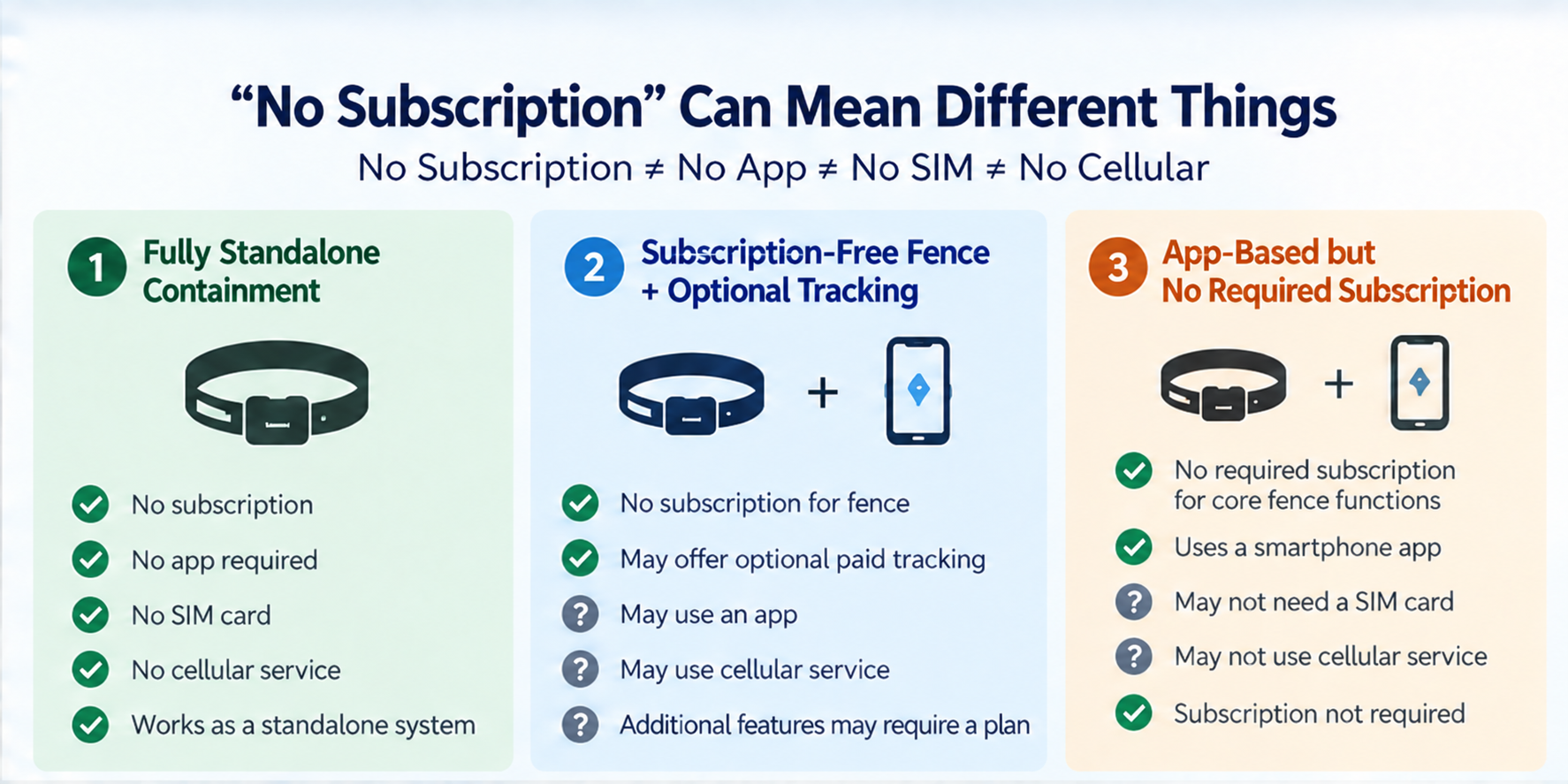
At its simplest, no subscription means you do not have to keep paying a recurring monthly or annual charge for the fence functions covered by the product. That sounds straightforward. In practice, there are several different models.

Comparison of three GPS dog fence models: standalone containment, optional paid tracking, and app-based fencing without a required subscription.

1. Fully Standalone Containment

A standalone GPS fence may perform its core containment functions directly through the collar or a dedicated controller. Depending on the product, this can mean no monthly service plan, no cellular plan, no SIM card, no cloud account, and no smartphone app required for normal operation.

This type of architecture is attractive to owners who mainly want a virtual boundary rather than a connected tracking platform.

2. Subscription-Free Fencing With Optional Paid Tracking

Some premium systems allow the virtual fence to operate without a recurring subscription but offer an optional service plan for additional functions. SpotOn, for example, currently states that its GPS fences do not require a subscription, while an optional plan adds features such as real-time tracking and escape alerts.

In this model, containment is subscription-free, but connected tracking features may not be.

3. Subscription-Free Fencing That Still Uses an App

“No monthly fee” also does not necessarily mean “no app.” PetSafe currently markets its Guardian GPS Dog Fence as subscription-free while using the My PetSafe app for custom fence setup. That may be perfectly suitable for someone who likes smartphone-based setup. It is simply different from a fully standalone system.

4. Systems Where a Membership Is Required

Other products bundle the fence into a connected service ecosystem. Halo currently states that a Pack Membership Plan is required to keep the collar active and to create, edit, and use its wireless fences.

These differences are why buyers should look beyond a headline such as “GPS fence” or “no subscription.” Subscription terms and product features can change, so always verify the manufacturer’s current terms before purchasing.

No Subscription Does Not Automatically Mean No App, SIM, or Wi-Fi

These terms are often grouped together, but they describe different things.

A subscription is a recurring payment arrangement. An app is the user interface a product may use for setup, fence creation, monitoring, settings, or notifications. A cellular connection can allow a collar to communicate over a mobile network, particularly for remote tracking and alerts. Wi-Fi may be used for initial setup, firmware updates, data synchronization, or other connected functions.

A GPS fence therefore can be subscription-free but app-based, subscription-free with optional cellular tracking, completely standalone without an app or cellular service, or subscription-based because its core functionality depends on a connected platform.

If your goal is technological simplicity, search for more than “GPS dog fence no subscription.” Also check whether the product requires an app, cellular service, Wi-Fi, a SIM card, a fixed base station, or a cloud account.

GPS Dog Fence vs. GPS Dog Tracker: Know What You Are Buying

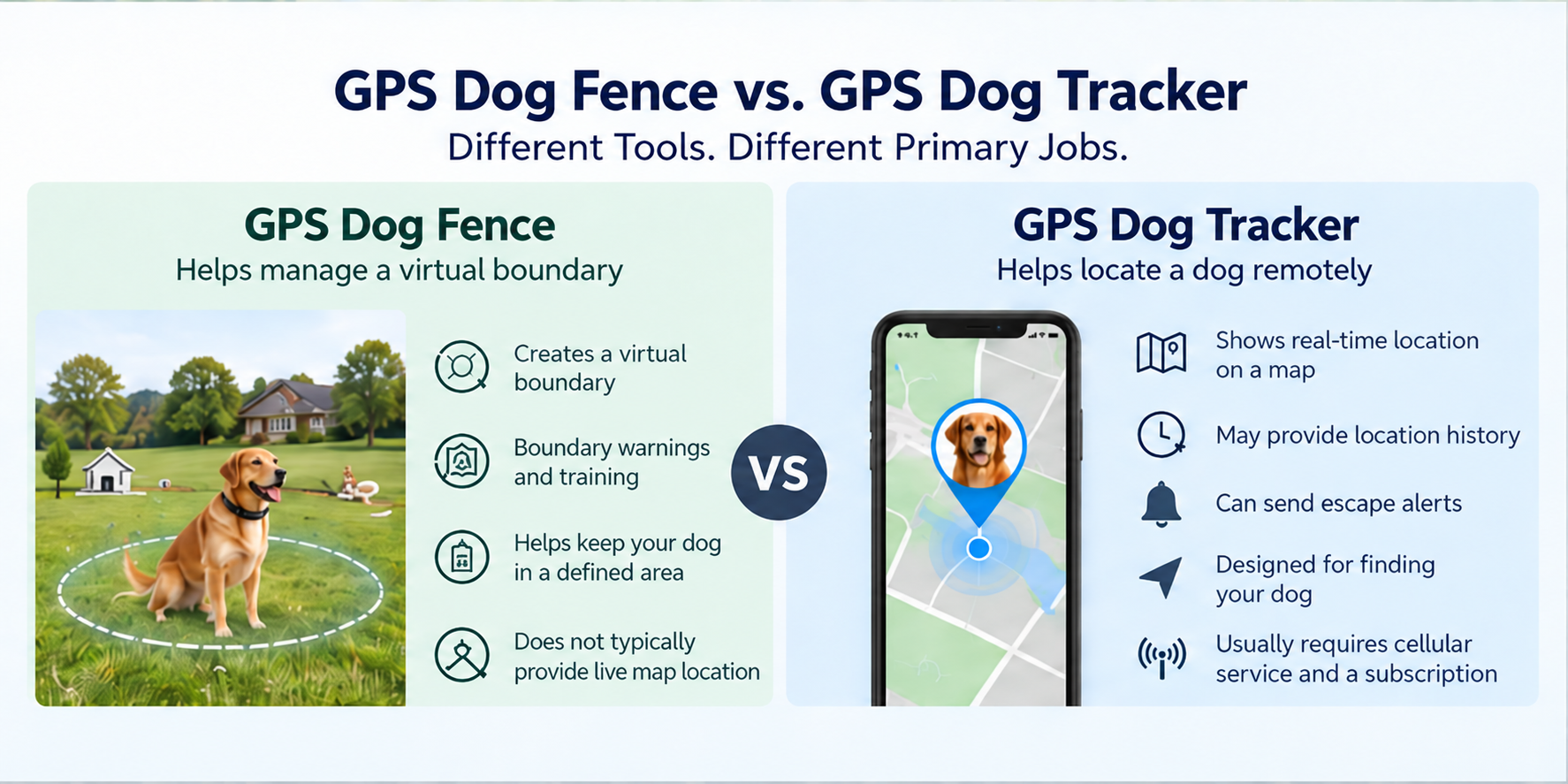
One of the most important distinctions in this category is the difference between containment and tracking.

A GPS Dog Fence Answers:

“Has my dog approached or crossed the boundary I established?”

The collar uses location information to determine its relationship to a virtual safety zone and can provide boundary feedback according to the system’s design.

A GPS Dog Tracker Answers:

“Where is my dog right now?”

A full tracking system may display the dog’s position on a map, provide location history, send escape notifications, or help the owner navigate toward the dog’s location.

A dog fence can provide containment functionality without being a complete live-map tracker. Likewise, a GPS tracker may tell you where your dog went without creating a training-based containment boundary.

Before purchasing, decide which problem matters more: keeping your dog within an established outdoor area, locating a dog after it leaves, or both.

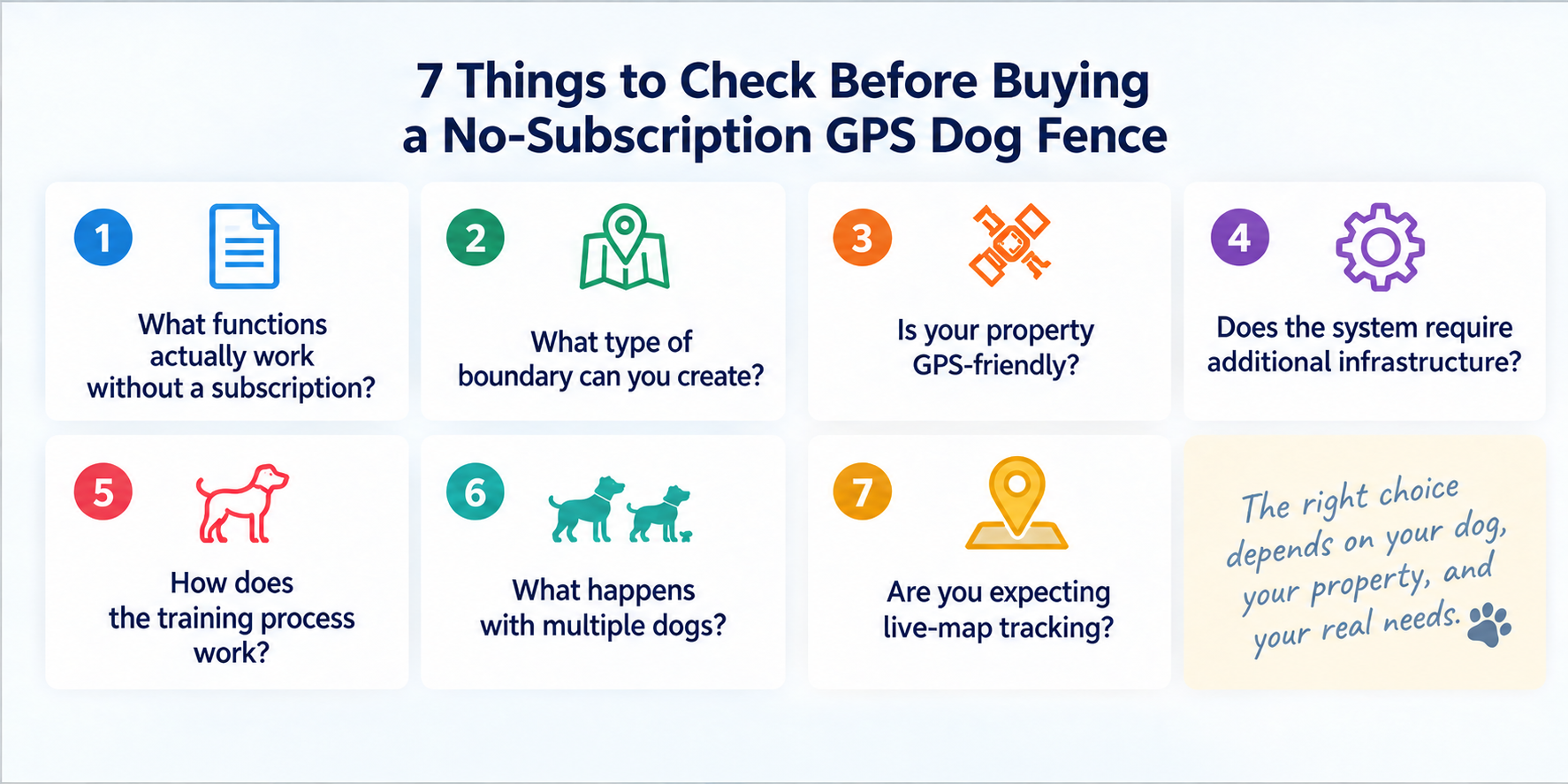
Seven Things to Check Before Buying a GPS Dog Fence With No Monthly Fee

1. What Functions Actually Work Without the Subscription?

Do not stop at a “no monthly fees” badge. Confirm whether creating and activating fences, editing boundaries, boundary warnings, training functions, multi-dog support, smartphone notifications, live tracking, location history, and escape alerts work without recurring payment.

A product can be legitimately subscription-free for containment while charging for completely different connected services. The important issue is whether the function you are buying the system for remains available.

2. What Type of Boundary Can You Create?

GPS fences do not all create boundaries in the same way. Some systems create a circular boundary around a center point. Others allow owners to draw irregular or custom-shaped boundaries through a smartphone map.

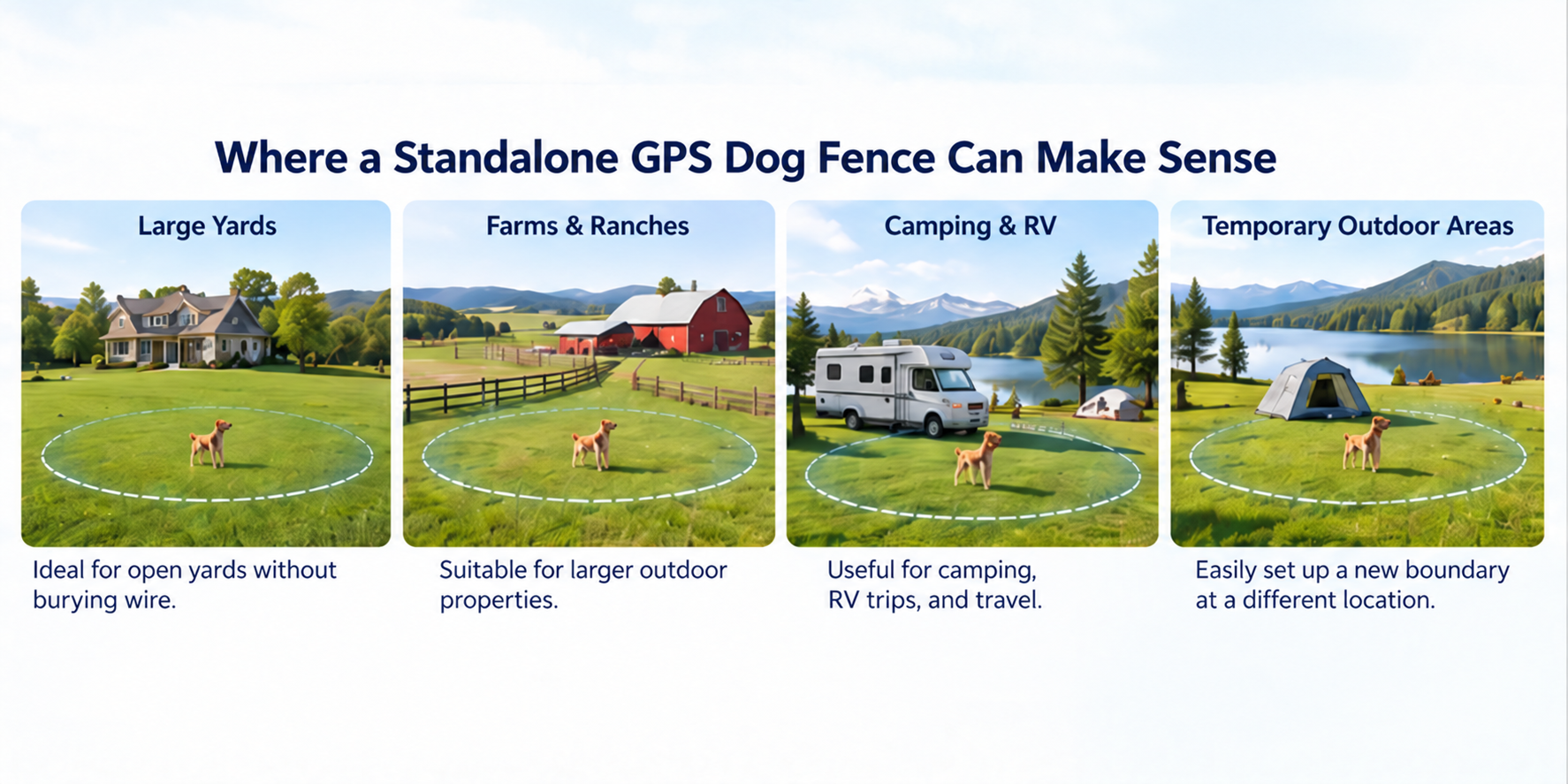
A circle may be appropriate for large yards, farms, ranches, open fields, campsites, and temporary outdoor areas. A custom-shaped map boundary may make more sense when you need to closely follow an irregular property line, exclude specific areas, or create complex zones.

Choose based on your property rather than the longest advertised range.

3. Is Your Property Suitable for GPS Containment?

GPS-based systems depend on receiving satellite signals. Positioning performance can be affected by satellite geometry, atmospheric conditions, signal blockage, receiver design, buildings, bridges, trees, indoor environments, and reflected signals.

That makes the physical environment an important part of the buying decision. GPS containment is generally better suited to open outdoor areas with good satellite visibility than to indoor spaces, dense high-rise environments, or locations with heavy obstruction.

4. Does the Fence Require Additional Infrastructure?

Depending on the system, ask whether you need buried boundary wire, a fixed transmitter, an outdoor antenna, a home base station, permanent power, Wi-Fi, or a smartphone.

If you plan to use the system at a farm, vacation property, campsite, or RV destination, verify how easily the boundary can be reset at a new location.

5. How Does the Training Process Work?

A virtual boundary is not the same thing as a physical barrier. Dogs need to learn what the warning cues mean and where the boundary is located.

Look for a system that allows a clear, progressive introduction to the boundary. Depending on the product, feedback may include tone, vibration, or static stimulation. If static stimulation is included, understand how it can be configured rather than treating higher intensity as a substitute for training.

Supervision, consistent boundary introduction, appropriate collar fit, and a thoughtful training process remain important.

6. What Happens When You Have Multiple Dogs?

Multi-dog support can mean very different things. Check whether additional collars are supported, whether each dog requires a separate plan, whether individual collars can be selected independently, whether training settings are controlled separately, and how the system identifies each dog.

Do not assume “multi-dog compatible” means unlimited collars.

7. Are You Expecting Live Tracking?

If your priority is “If my dog gets lost, I want to open my phone and see the exact location on a map,” you should specifically shop for live GPS tracking, not simply a GPS fence.

If your priority is “I need a virtual outdoor boundary without digging or paying every month,” a standalone GPS containment system may fit better.

When Does a No-Subscription GPS Dog Fence Make the Most Sense?

A subscription-free GPS fence can be particularly attractive when you have a clear containment problem and do not need a large connected-services package.

Large Open Yards

GPS boundaries can avoid the trenching and permanent installation associated with buried-wire systems.

Farms, Ranches, and Acreage

Owners of larger outdoor properties may value the ability to establish a broad virtual boundary without constructing physical fencing solely for electronic containment.

Camping and Temporary Locations

A resettable GPS boundary can be useful when the product allows you to establish a new safe area after moving to another suitable outdoor location. A virtual fence should not replace appropriate supervision or campsite rules, but portability can be useful compared with permanent installations.

Owners Who Dislike Recurring Services

Some people simply want the containment hardware to continue working without maintaining another account or monthly payment.

Owners Who Do Not Need Smartphone Map Tracking

If your core requirement is containment rather than remote map-based location tracking, paying for a tracking ecosystem may provide features you rarely use.

When Might a Different System Be Better?

Exact Map-Based Lost-Dog Tracking

Choose a true tracking product if locating an escaped dog on a smartphone map is the main priority.

Highly Irregular Property Boundaries

A simple circular GPS fence may not fit a narrow, unusually shaped, or property-line-sensitive area.

Indoor Containment

GPS systems are fundamentally dependent on satellite reception and are generally not designed as indoor boundary tools.

Very Small or Heavily Obstructed Yards

A different wireless architecture, an in-ground fence, a physical fence, or another management approach may provide a better fit depending on the environment.

A Physical Barrier

Electronic containment does not prevent other animals or people from entering your property. If you need a true physical barrier, a traditional fence serves a different purpose.

Where NAX100 Fits in the No-Subscription GPS Fence Category

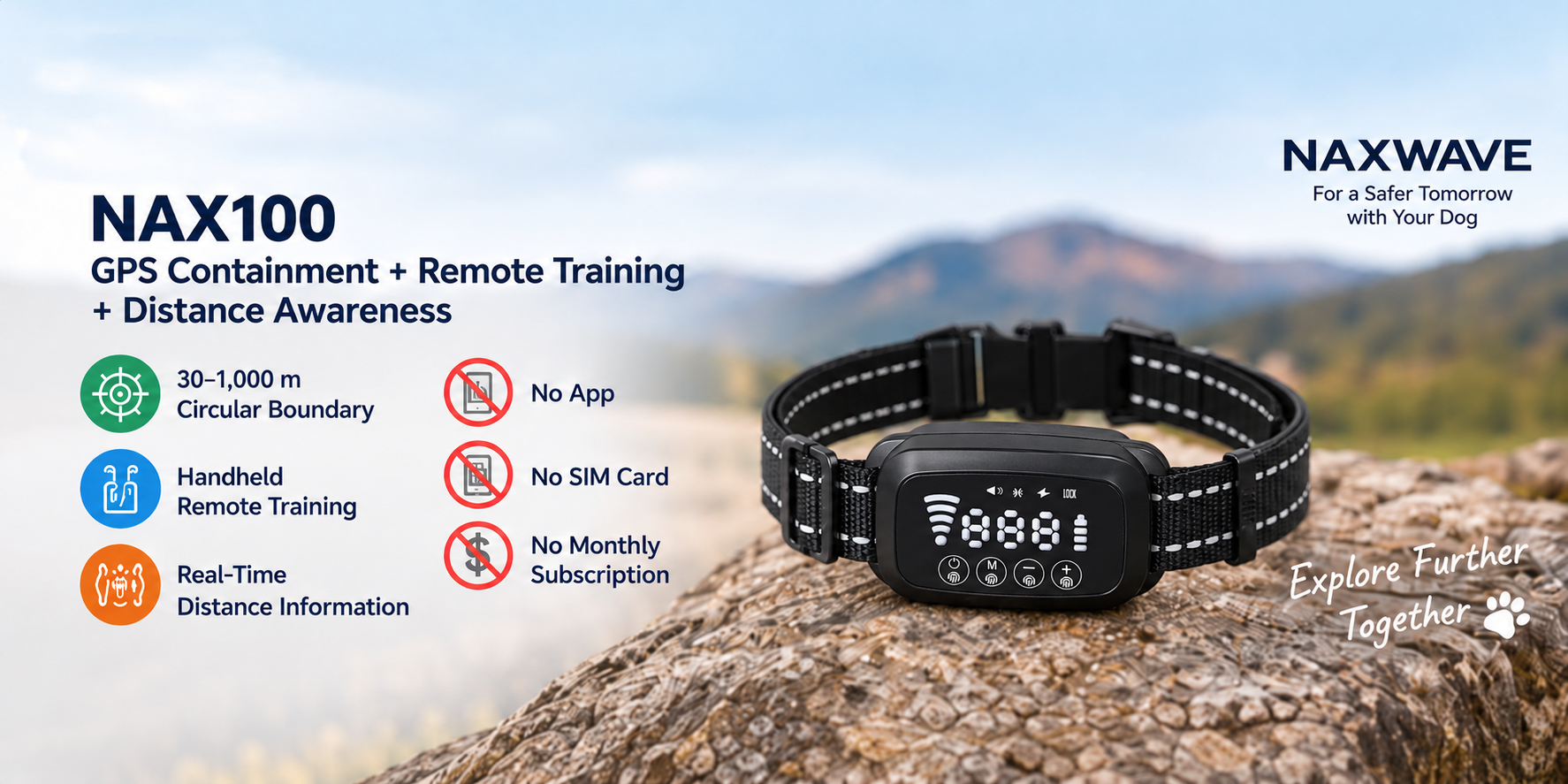
NAXWAVE’s NAX100 is designed for dog owners whose priorities are GPS pet containment, straightforward standalone operation, and remote dog training rather than a complex connected tracking ecosystem.

NAX100 creates a circular GPS virtual boundary using a user-defined center point and an adjustable radius from 30 to 1,000 meters. It is designed for open outdoor environments with adequate GPS satellite visibility.

For its core operation, NAX100 does not require:

  • buried boundary wire;
  • a fixed fence base transmitter;
  • a smartphone app;
  • a SIM card;
  • cellular service;
  • Wi-Fi;
  • a monthly subscription.

The system also includes a handheld remote controller for manual dog training functions including beep, vibration, and static stimulation. It supports channel switching for multi-dog or multi-collar control, And supports up to 3 dogs to control simultaneously

Another feature is real-time distance monitoring. The remote can provide information about approximately how far the dog collar is from the owner or remote side, along with signal and battery information.

Important distinction: NAX100 distance monitoring should not be confused with full GPS tracking. Current product documentation does not support claims of smartphone live-map tracking, route history, location history, map navigation to the dog’s exact position, or custom smartphone-drawn polygon fences. Distance information tells you approximately how far away the collar is; it does not tell you the dog’s exact location on a map.

That makes NAX100 better aligned with buyers who want GPS containment + remote training + distance awareness + no recurring service dependency, rather than buyers whose main requirement is a connected live-tracking platform.

A Simple Checklist Before You Buy

A GPS dog fence with no subscription may be a good fit if you can answer yes to most of these questions:

  • Do I mainly need containment rather than exact live-map tracking?
  • Is my property an open outdoor area with reasonable GPS satellite visibility?
  • Is the fence’s boundary shape compatible with my property?
  • Do I understand exactly which functions work without recurring fees?
  • Have I checked whether an app, cellular service, Wi-Fi, or a base station is required?
  • Can I introduce the boundary gradually and train my dog consistently?
  • If I have multiple dogs, have I confirmed how additional collars are managed?
  • If I travel, can the boundary be reset at another suitable location?
  • Am I comfortable with the difference between distance information and true location tracking?

If several answers are no, the lack of a subscription probably should not be the deciding factor.

Final Thoughts

Choosing a GPS dog fence without a subscription is less about avoiding one monthly charge and more about deciding how much technology you actually need.

For some owners, a connected GPS ecosystem with smartphone maps, tracking, notifications, and advanced boundary creation is worth the added complexity or recurring cost.

For others, the job is simpler: establish a virtual outdoor boundary, train the dog to understand it, and keep the system working without another ongoing service plan.

If that describes your needs, a standalone subscription-free GPS dog fence deserves serious consideration.

The best choice is the one whose boundary design, GPS environment requirements, training approach, connectivity model, and tracking capabilities match your property and the way you actually manage your dog—not simply the product with the longest feature list.

For buyers who specifically want standalone GPS containment combined with handheld remote training and distance monitoring, NAX100 represents one approach within this simpler no-subscription category.

Explore NAXWAVE GPS Dog Fences

Compare the NAX100 GPS Wireless Dog Fence and the NAX101 GPS Wireless Dog Fence with Remote Training. Review each product page for its features and setup requirements before choosing a system for your dog and property.

Explore GPS dog fence products

GPS Dog Fence vs. GPS Tracker: Which Does Your Dog Need?
Next
GPS Dog Fence vs. GPS Tracker: Which Does Your Dog Need?
Read More
By continuing to browse this website, you agree to our use of cookies.