If you are choosing between a GPS dog fence and a GPS dog tracker, start with one question:
Do you want to help prevent your dog from crossing a boundary, or do you want to find your dog after it has left?
That is the main difference.
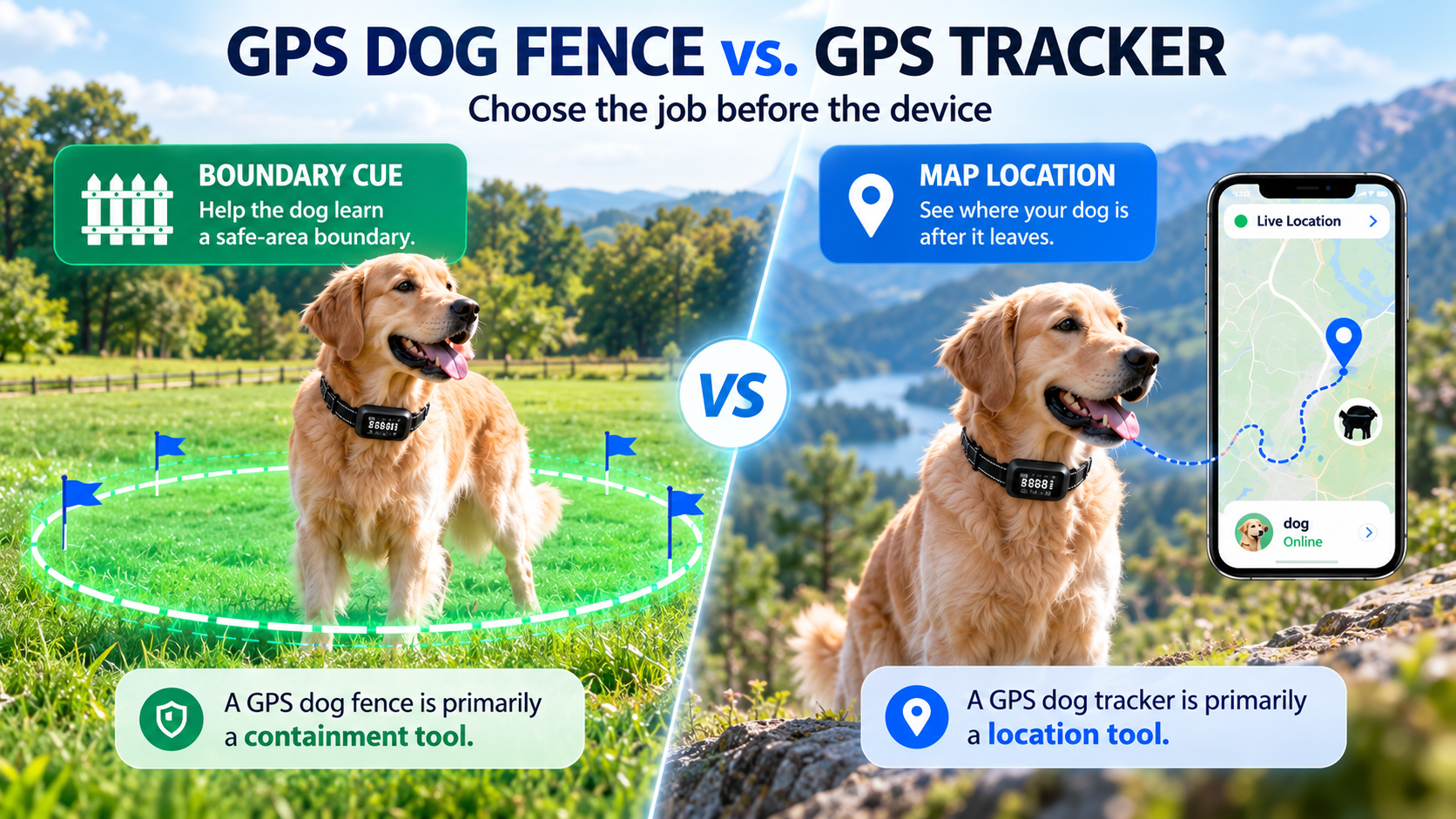
A GPS dog fence is primarily a containment tool. It uses GPS to create a virtual boundary and may give the dog a warning or cue as it approaches that boundary.
A GPS dog tracker is primarily a location tool. It is designed to tell the owner where the dog is, usually by showing its location on a map.
Some products combine both functions, but many do not. Understanding this difference can prevent you from buying a collar that uses GPS but does not actually solve the problem you have.
GPS Dog Fence vs. GPS Tracker
Choose a GPS dog fence if your main goal is:
keeping your dog within a defined outdoor area;
creating a virtual boundary without burying wire;
helping the dog learn where it should turn back.
Choose a GPS dog tracker if your main goal is:
seeing where your dog is;
locating the dog after it leaves your property;
using map-based location information for recovery.
The easiest way to remember the difference is:
GPS fence = boundary prevention
GPS tracker = location recovery
Neither one is a physical barrier, and the word “GPS” alone does not mean a device can do both.
A GPS dog fence compares the collar's position with a virtual boundary.
Depending on the product, the owner may create a boundary around a center point or define another supported boundary shape. When the dog approaches or crosses that boundary, the collar can respond according to its programmed settings.
The important point is that the system is designed to influence what happens at the boundary.
For example, a fence collar may provide:
a beep or tone;
vibration;
another configured boundary cue.
The dog is gradually taught to associate those cues with the edge of the permitted area.
So if you have a large yard, farm, ranch, campsite, or other open outdoor area and your main problem is:
“How can I help keep my dog inside this area?”
a GPS dog fence is the more relevant category.
However, a GPS fence should not automatically be treated as a GPS tracker.
A collar can know whether it is inside or outside a virtual boundary without providing the owner with a live map showing the dog's exact location.
For a broader introduction, see our GPS dog fence manufacturer guide.
A GPS dog tracker is designed around a different question:
“Where is my dog right now?”
Many tracking collars send location information to a smartphone app. The owner can then view the dog's position on a map.
Depending on the product, a tracker may also offer features such as:
escape alerts;
location history;
direction information;
route or navigation assistance.
These features are useful when the dog has already moved away from the owner or left the property.
A tracker may also include a geofence.
This is where buyers often become confused.
A tracker's geofence usually means that the owner receives an alert when the dog leaves a defined area.
That is not necessarily the same as a containment fence.
For example:
Tracker geofence:
“Your dog has left the safe area.”
Containment fence:
The collar gives the dog a boundary cue intended to help it turn back.
Some systems can do both. Others can only do one.
That is why the phrase “virtual fence” is not enough to determine what a product actually does.
There is another feature that often causes confusion: distance monitoring.
Suppose a handheld device tells you that your dog is 200 meters away.
That information can be useful.
But it does not necessarily tell you where the dog is.
The dog could be 200 meters north, south, east, or west of you.
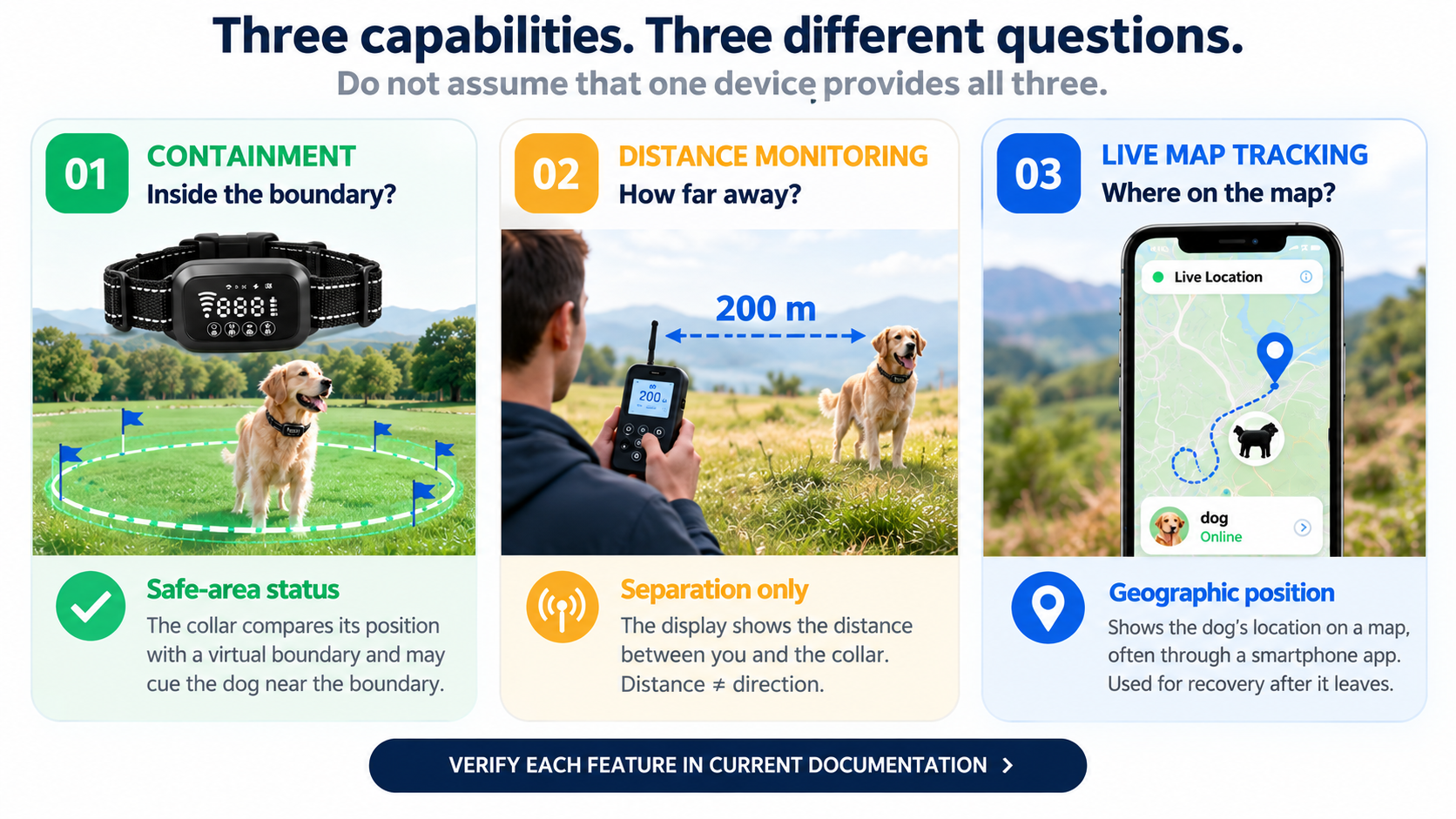
So these are three different capabilities:
| Capability | Question it answers |
|---|---|
| GPS containment | Is the dog inside the permitted boundary? |
| Distance monitoring | How far away is the dog? |
| Live GPS tracking | Where is the dog on a map? |
A product that shows distance should not automatically be described as a live GPS tracker.
If map-based recovery is important to you, look specifically for documented features such as live map location, coordinates, direction, or location history.
The decision becomes much easier when you focus on your primary problem.
A GPS fence makes more sense when your dog is normally with you or on your property, but you want to establish an outdoor area it should not leave.
Typical situations include:
large yards;
farms;
ranches;
open rural properties;
campsites;
temporary outdoor areas.
The main objective is not to find the dog after it disappears.
The objective is to help manage the boundary before the dog travels farther away.
A tracker makes more sense if your biggest concern is:
“If my dog gets away, how do I locate it?”
For that situation, map location is more important than an on-collar boundary cue.
If you specifically need to see the dog's geographic position, do not assume a GPS fence provides that capability simply because it contains a GPS receiver.
Look for explicit documentation of live map tracking.
Some collars combine containment and tracking.
If you want both, check that the product clearly documents:
on-collar boundary feedback for containment; and
live map location for tracking.
Do not rely only on terms such as “GPS collar,” “smart collar,” “virtual fence,” or “anti-lost.”
The actual functions matter more than the product category name.
NAX100 is designed primarily as a GPS wireless dog fence with remote training and real-time distance monitoring.
It creates a circular virtual boundary using a user-defined center point and an adjustable radius from 30 to 1,000 meters.
The system can provide boundary feedback through beep, vibration, and optional static stimulation according to its settings.
It also includes a handheld remote for remote training and displays information including signal status, distance, and battery level.
Its core functions do not require:
buried boundary wire;
a fixed fence base transmitter;
a smartphone app;
a SIM card;
cellular service;
a monthly subscription.
The important distinction is that NAX100 is not documented as a full map-based live GPS tracker.
Its distance display can help you understand approximately how far away the collar is, but distance information is not the same as seeing the dog's position on a map.
Current product information does not establish phone-based live maps, exact coordinates, direction finding, location history, or route navigation.
So NAX100 is a better fit when your priority is:
virtual boundary management + remote training + distance awareness
rather than:
live map-based dog recovery.
When comparing a GPS dog fence vs. GPS tracker, do not start by asking which device has more features.
Start by asking what problem you need to solve.
If your priority is:
“I want to help keep my dog inside a defined outdoor area.”
Choose a GPS dog fence.
If your priority is:
“I want to see where my dog is after it leaves.”
Choose a GPS dog tracker.
“Want to keep your dog within a defined area while also having dog training and distance monitoring functions?” Choose NAX100.
For product specifications and setup information, see the NAX100 GPS Wireless Dog Fence. Continue with A Dog Owner’s Guide to GPS Fences, Electronic Collars and Trackers when comparing options for your dog and property.